 How-to
Mobile Diesel Repair Diagnostic Capabilities: What Can Be Fixed On-Site
Table of Contents
- What Mobile Diesel Diagnostics Actually Does
- Heavy-Duty Truck Diagnostic Scanner Tools and Equipment
- Diesel Engine Fault Code Diagnosis: Reading and Clearing Codes
- Diesel Emissions System Diagnostics and Regeneration Commands
- Live Data Monitoring and Parameter Testing
- What Mobile Diagnostics Cannot Resolve Roadside
- Guided Troubleshooting and Symptom-Based Diagnostics
- Why Compatibility and Protocol Matter for Your Equipment
- Frequently Asked Questions
Last Updated: October 14, 2026
What Mobile Diesel Diagnostics Actually Does
Mobile diesel repair diagnostic capabilities allow technicians to identify engine problems and emissions issues without hauling your truck or equipment to a shop. A technician arrives with specialized scanners and software, connects to your vehicle's diagnostic ports, and reads fault codes that pinpoint what's wrong.
At M&D Repair Services, we bring this diagnostic power directly to you. The process saves time and money by letting us assess problems on-site.
The real value isn't just convenience. Mobile diagnostics gives you transparency. You see what the scan found. You understand the repair before committing to it. No surprises when the bill arrives.
Heavy-Duty Truck Diagnostic Scanner Tools and Equipment
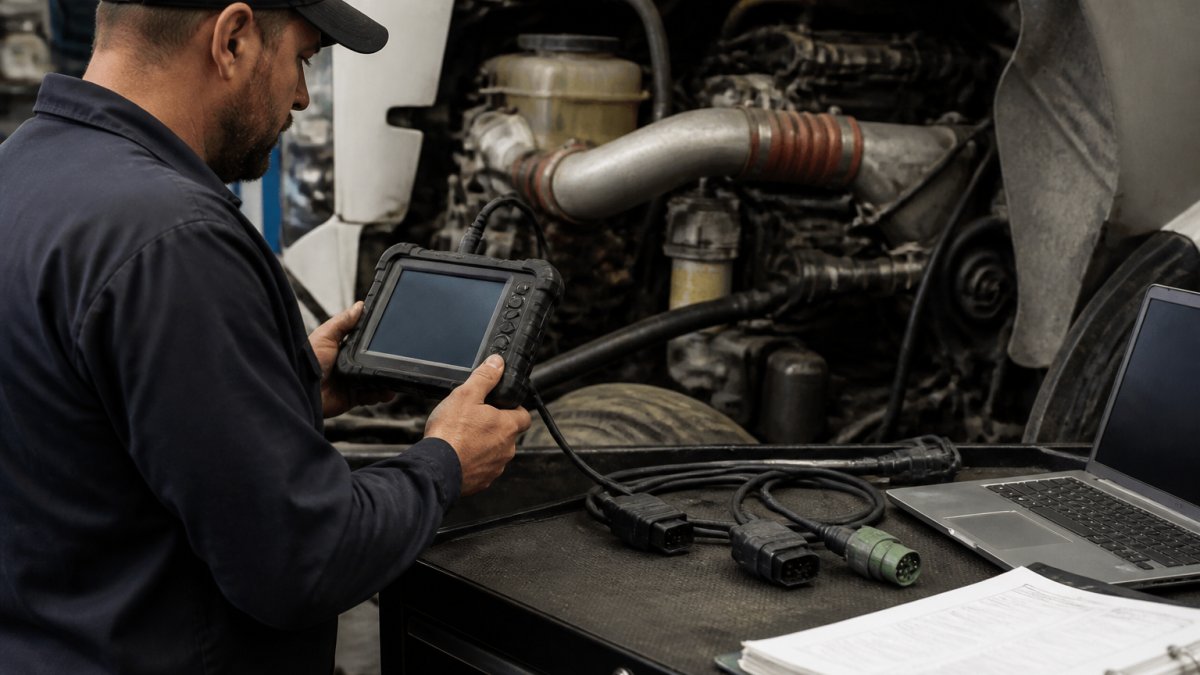
Diesel diagnostics relies on two main types of equipment: handheld scanners and laptop-based software systems. Both read fault codes and live engine data, but they differ in power, portability, and what they can access.
Handheld Scanners vs. Laptop-Based Software
Handheld scanners are rugged, portable devices that connect directly to a truck's OBD-II port. They're fast to set up, work in the field without extra power, and display fault codes clearly.
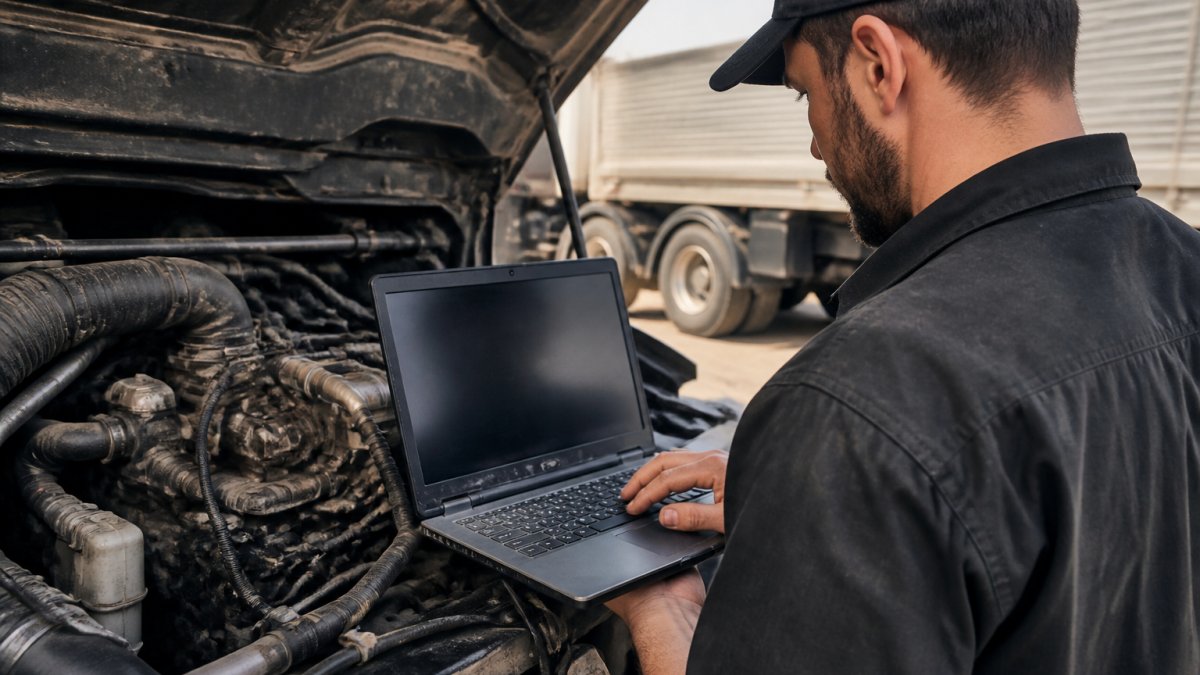
Laptop-based software offers deeper access to vehicle modules. It can read more fault codes, run advanced tests, and sometimes clear codes that handheld units cannot.
Many shops use both. A handheld scanner is your first line of assessment. If the problem isn't obvious, laptop software digs deeper. For roadside work, a good handheld scanner handles most common faults.
Connectivity and Power Requirements in the Field
Handheld scanners run on rechargeable batteries. Most last 8-12 hours per charge. Before heading out, confirm your scanner is fully charged. A dead battery in the field means no diagnostics.
Laptop systems need consistent power. You'll need either a vehicle power inverter or a portable battery pack. A standard 12V inverter won't cut it for extended diagnostics. Invest in a quality 2000-watt inverter or a dedicated lithium battery pack.
Connectivity matters too. Some diagnostic software requires internet access to download the latest vehicle data or upload results. Others work offline but need periodic updates. Before a job, confirm your device has the software version needed for that vehicle's year and make.
Diesel Engine Fault Code Diagnosis: Reading and Clearing Codes
Fault codes are the language engines speak. When a sensor detects a problem, the engine stores a code. Your job is to read that code and understand what it means.
Codes follow a standard format: P followed by four numbers. P0001 might mean "fuel injector circuit malfunction." P0400 might mean "EGR flow malfunction." Each code points to a specific system or sensor.
How Fault Codes Point to the Problem
A fault code narrows the search. It doesn't always name the exact broken part. Instead, it points to the system that failed.
Live data helps here. After reading a code, pull live data from that sensor. Watch the numbers change as you rev the engine or move the throttle. If the sensor data looks wrong, you've found your culprit.
Clearing codes is the final step. Once you repair the issue, clear the code. The engine will relearn and confirm the fix worked. If the code returns immediately, the problem wasn't fully resolved.
VIN Decoding and Vehicle Module Identification
Your first step is always VIN decoding. The Vehicle Identification Number tells you the engine type, emissions equipment, and transmission. Different engines have different diagnostic protocols. A 6.7L Cummins needs different tests than a 7.3L PowerStroke.
Decode the VIN using your diagnostic software. It pulls up the correct vehicle profile. This ensures your scanner accesses the right modules. Without the correct VIN data, you might miss available fault codes or misinterpret the ones you find.
Vehicle modules are separate computers within the engine system. The engine control module (ECM) manages fuel injection and ignition timing. The transmission control module (TCM) manages gear shifts. The body control module (BCM) handles lights and accessories.
Diesel Emissions System Diagnostics and Regeneration Commands
Diesel emissions systems are complex. They include the diesel particulate filter (DPF), selective catalytic reduction (SCR) system, and exhaust gas recirculation (EGR). Each has its own sensors and fault codes.
The DPF traps soot. When it fills, the engine triggers a regeneration cycle to burn out the soot. If regeneration fails, fault codes appear. Your diagnostic software can read DPF pressure sensors and command a manual regen if needed.
SCR systems inject urea to reduce nitrogen oxides. If urea quality is poor or the injector clogs, codes appear. Diagnostics can verify urea heater function and injector spray patterns.
Aftertreatment System Testing and Verification
Aftertreatment components work together. Testing one in isolation isn't enough. You need to verify the entire system functions as a unit.
Start by reading all emissions-related fault codes. Then pull live data from each sensor: DPF pressure, SCR inlet and outlet temperatures, urea tank level, and NOx sensor readings.
Some diagnostics software allows you to command test functions. You can trigger a DPF regen, test the urea heater, or command the EGR valve open and closed.
Verification is critical. After repair, rerun the same tests. Confirm fault codes are gone and live data returns to normal ranges. A quick verification prevents comebacks and confirms the customer's money was well spent.
Live Data Monitoring and Parameter Testing
Live data is real-time information from engine sensors. Watching live data tells you how the engine is actually running, not just what fault codes say went wrong.
Pull up live data and let it stream for 30 seconds. You'll see fuel pressure, rail pressure, boost pressure, coolant temperature, and dozens of other parameters. Normal ranges vary by engine and model year. Your diagnostic software should show the expected range for comparison.
Fuel Injection and Injector Cutout Testing
Fuel injectors are precision components. A dirty injector or a failing solenoid creates misfire codes and rough idle. Diagnostics can test injector function in two ways.
First, pull live data on fuel rail pressure and injector pulse width. Pulse width is how long the injector stays open. If one cylinder's pulse width is significantly different from others, that injector is suspect.
Second, use injector cutout testing. This command disables one injector at a time while the engine idles. You listen and feel for a change in engine roughness.
Injector cutout testing is a field-proven method. It's simple, fast, and doesn't require expensive equipment. Many technicians prefer it to software-only diagnostics because you feel the engine response directly.
What Mobile Diagnostics Cannot Resolve Roadside
Mobile diagnostics has real limits. Knowing those limits saves time and prevents failed repairs.
You cannot diagnose internal engine damage with a scanner. If an engine has a cracked piston or worn rings, no fault code will tell you. You need a compression test, a borescope inspection, or a full teardown. Mobile diagnostics cannot replace mechanical inspection.
You cannot diagnose transmission problems with certainty in many cases. Transmission codes point to solenoids, sensors, or fluid pressure issues. But internal transmission wear or clutch pack failure requires transmission fluid analysis or a teardown. Diagnostics can narrow it down, but often cannot confirm the exact problem.
When Parts or Specialized Equipment Are Required
Some repairs need parts you won't have on hand. If diagnostics shows a failed fuel injector, you need a replacement injector. If the DPF is clogged beyond recovery, you need a new filter. Mobile diagnostics identifies the problem but doesn't solve it if parts aren't available.
Specialized equipment also limits roadside repair. A fuel injection pressure test requires a fuel pressure gauge. A DPF regen requires specific software commands. Some diagnostics tools cannot perform these tests. You might need to tow the vehicle to a shop with full equipment access.
Diagnostic Accuracy and Verification Limits
Fault codes can mislead. A P0101 code (mass airflow sensor malfunction) might actually point to a vacuum leak, not the sensor itself. Diagnostics narrows the search but doesn't always pinpoint the exact cause.
Environmental factors affect accuracy. Cold weather can trigger codes that disappear when the truck warms up. A loose battery terminal can cause electrical codes that vanish after cleaning the connection. Diagnostics reveals the symptom, not always the root cause.
Verification is your safety net. After repair, rerun diagnostics and confirm the code is gone. Drive the truck and watch for the problem to return. If it does, the diagnosis was incomplete. Go back and dig deeper.
Guided Troubleshooting and Symptom-Based Diagnostics
Not every problem starts with a fault code. Sometimes a truck runs rough but no codes appear. Symptom-based diagnostics works backward from what you observe.
Start with the customer's description: rough idle, loss of power, hard starting, black smoke, white smoke, blue smoke. Each symptom points to different systems. Rough idle suggests fuel injection or ignition timing.
Guided diagnostics software walks you through a decision tree. It asks questions: Does the truck start? Does it idle rough? Does it lose power under load? Each answer narrows the possibilities.
This approach is faster than scanning every module blindly. It's especially useful when multiple codes appear and you're not sure which to address first.
Why Compatibility and Protocol Matter for Your Equipment
Not all diagnostic tools work on all engines. A scanner designed for light-duty pickups may not access heavy-duty truck modules. Protocol support is critical.
Engine Type, Truck Make, and Diagnostic Coverage
Diesel engines use different protocols. Cummins engines use one standard. Duramax engines use another. PowerStroke engines use a third.
Truck make matters too. A 2020 Cummins needs different diagnostic access than a 2010 Cummins.
Coverage gaps are real. OEM diagnostic systems (factory software) access everything but cost thousands. M&D Repair Services invests in diagnostic tools that balance coverage and affordability.
Before purchasing or relying on a diagnostic tool, confirm it supports the engines you'll service most.
Mobile diesel repair diagnostic capabilities give you the power to identify problems accurately and fix them right the first time.
The key is matching the right diagnostic approach to each problem. Simple faults respond to handheld scanners and live data.
M&D Repair Services brings professional-grade diagnostics to your location with transparent communication about what we find and what it costs to fix.
Frequently Asked Questions
What can a mobile diesel mechanic diagnose on-site?
Mobile diesel diagnostics can read and clear fault codes, monitor live engine data, test fuel injection systems, check aftertreatment performance, and decode vehicle identification numbers to pinpoint electrical and emissions issues. However, diagnosis is limited to problems that don't require parts replacement or specialized shop equipment. If repairs need internal engine work, transmission service, or welding, the vehicle will need to go to a full service facility.
Can a mobile mechanic diagnose a check engine light on a diesel?
Yes. A mobile diesel diagnostic scanner connects to your truck's onboard computer and retrieves the fault codes triggering the check engine light. The technician can then use guided diagnostics to trace the code to its source, whether it's a sensor fault, fuel system issue, or emissions system problem. Live data monitoring confirms whether the underlying component is actually failing or if the code was triggered by a temporary condition.
What diagnostic tools do mobile diesel technicians use?
Mobile technicians use handheld scanners, laptop-based diagnostic software, multimeters for electrical testing, and wiring diagram references. Handheld scanners are portable and work for basic fault-code reading; laptop software offers deeper live-data monitoring and service functions. Both require a reliable power source and vehicle connectivity. The tool choice depends on the truck's protocol, the technician's equipment, and the complexity of the problem being diagnosed.
How long does a mobile diesel diagnostic take?
A basic fault-code read and clear typically takes 15-30 minutes. Guided troubleshooting to isolate the root cause of a check engine light or performance issue usually takes 45 minutes to 2 hours, depending on problem complexity and whether live-data verification is needed. Emissions system diagnostics and regeneration testing may take longer. Actual time depends on what the initial scan reveals and whether the technician needs to test multiple engine systems or modules.