 How-to
Heavy Duty Truck Suspension Repair: What to Expect
Last Updated: November 21, 2026
Quick Summary
Truck suspension repair starts with an on-site inspection of the whole corner, not one part, because bounce, lean, vague steering, uneven tire wear and clunks are warnings that get worse fast on a loaded truck. Park the truck when symptoms affect control, and book service before the next heavy load for everything else.
- Any one suspension warning sign deserves an inspection; two or more mean the truck comes off the road.
- Replacing shocks to fix a bounce from worn springs or a leaking air bag masks the problem and fails early.
- A truck that leans overnight and levels after startup points at a slow air bag or valve leak.
- Mobile repair brings the service to your yard, jobsite or roadside location; confirm coverage before booking.
- Park the truck for wandering steering, a hard pull, visible lean, a broken spring or an air bag that won't hold pressure.
Table of Contents
- Heavy Duty Truck Suspension Repair Symptoms You Should Not Ignore
- How On-Site Diagnosis and Repair Works, Step by Step
- Shocks, Struts, Springs and the Components That Wear Out
- Mobile Heavy Duty Truck Suspension Repair Near Me: How It Works
- Truck Suspension Repair Cost: What Drives the Estimate
- Heavy Duty Truck Suspension Repair Time: What Affects the Schedule
- Heavy-Duty and Fleet Suspension Systems: Air, Leaf and Undercarriage Work
- When to Park the Truck and Call for Service
- Frequently Asked Questions
Heavy Duty Truck Suspension Repair Symptoms You Should Not Ignore
A heavy duty truck suspension repair near me search usually starts the same way: something felt wrong on the last run. Maybe the cab started bouncing after a bump and never settled. Maybe the steering wandered at highway speed. Those are not comfort issues. They are warnings.
These symptoms should be treated as a priority, not a nuisance. Suspension problems on a loaded commercial truck get worse fast, and they take tires, brake lines and steering components with them.
Watch for these signs:
- Uneven tire wear, especially cupping or flat spots on one side
- Excessive bounce after bumps that takes more than a cycle to settle
- Leaning or sagging on one corner, even when parked on level ground
- Loose or vague steering that needs constant correction
- Clunking, squeaking or banging over rough pavement
- Nose dive under braking or excessive squat under load
- Visible cracks, leaks or bent parts under the truck
Any one of these deserves a suspension inspection. Two or more means the truck should come off the road until it's diagnosed. Driving on a failing leaf spring or a leaking air bag risks a breakdown at the worst possible moment, and it puts the driver and everyone around them at risk.
These are the warning signs that mean the suspension needs inspection, not just a smoother ride.
| Symptom | What it looks like |
|---|---|
| Uneven tire wear | Cupping or flat spots on one side |
| Excessive bounce | Takes more than a cycle to settle after bumps |
| Leaning or sagging | One corner low even when parked on level ground |
| Loose or vague steering | Needs constant correction |
| Clunking, squeaking or banging | Noise over rough pavement |
| Nose dive or squat | Dives under braking, squats under load |
| Visible damage | Cracks, leaks or bent parts under the truck |
How On-Site Diagnosis and Repair Works, Step by Step
Downtime matters for contractors and farmers. A typical on-site process looks like this:
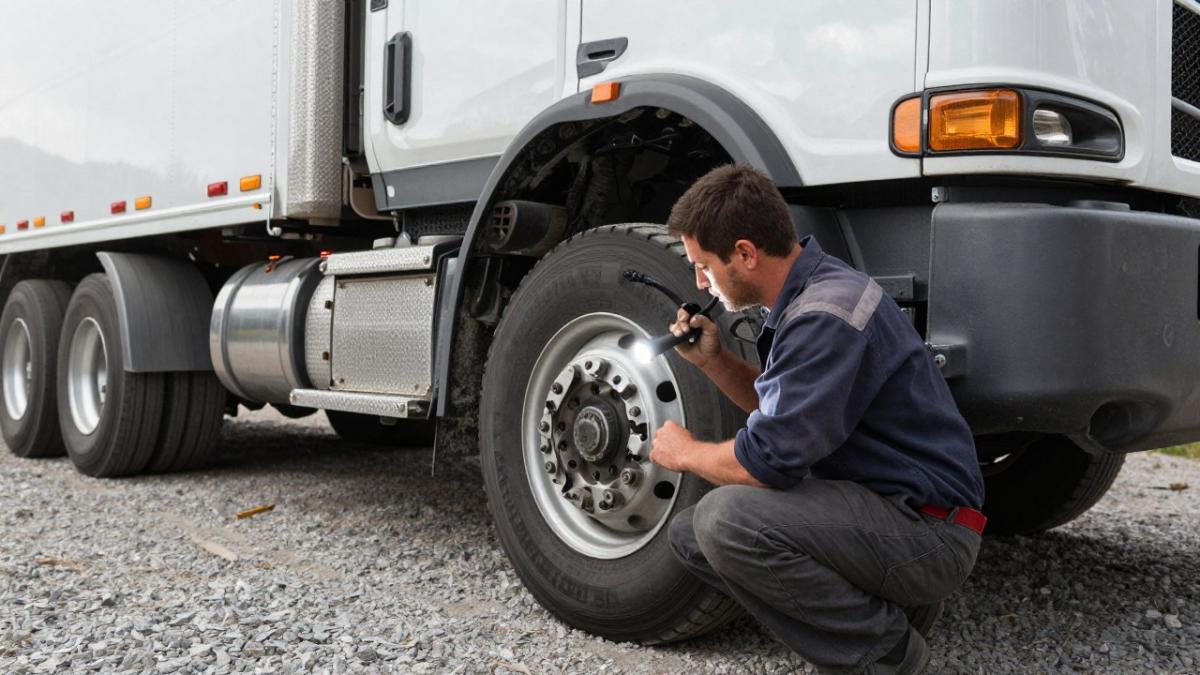
What the Technician Inspects
If you want to see the full scope of what we handle on site, you can learn more about our services.
Shocks, Struts, Springs and the Components That Wear Out
Every suspension failure traces back to a part that wore out, and on a heavy-duty truck the wear pattern usually tells you which part it is before anything comes apart. The systems below are the ones that actually carry the load on commercial trucks, and each fails in its own recognizable way.
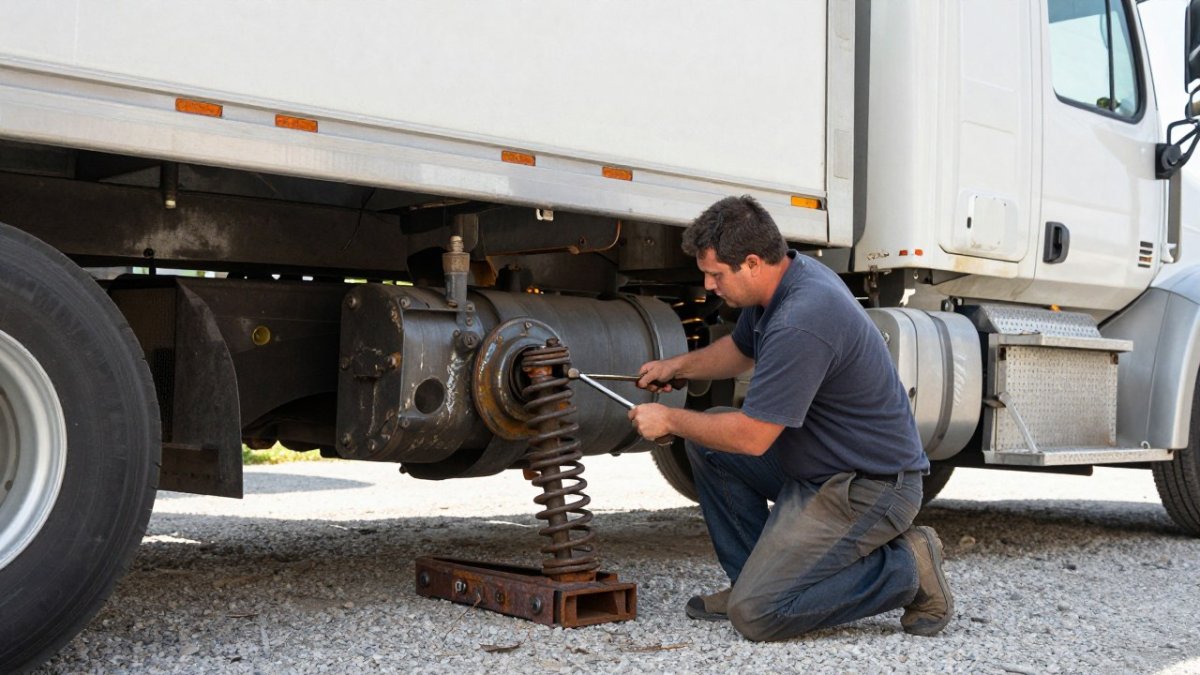
Leaf springs and spring packs. Most heavy-duty trucks still ride on multi-leaf packs. The pack carries the load, locates the axle, and absorbs the first hit from the road. Packs fail at the eyes, at the center bolt, and through cracked leaves that start as a hairline and spread under load. A truck that sits lower on one corner, or whose spring eyes are oval instead of round, is telling you the pack has lost arc or the bushings are gone. Replacing a single broken leaf is sometimes possible, but a pack that has lost its arc as a set usually needs the whole pack, because a new leaf mixed with tired leaves loads unevenly.
Heavy-duty shock absorbers and struts. Shocks on a loaded truck do more than smooth the ride. They control axle wind-up, keep the tires planted under braking, and damp the bounce that a heavy leaf pack would otherwise keep going. A shock that has lost its gas charge will still bolt up and look fine, which is why bounce tests and leak checks matter more than a visual glance. Worn shocks show up as cupped tire wear, longer stopping distance, and a cab that keeps rocking after a bridge joint.
Air suspension: bags, leveling valves, and height sensors. Air systems replace steel with pressure, and they fail differently. Air bags crack at the fold and leak slowly, so the truck may sit level in the yard and squat only after an hour on the road. Leveling valves stick and either over-inflate one side or leave it low. Height sensors and linkage rods bend or seize. A common pattern is a truck that leans overnight and levels itself after startup, which points at a slow bag or valve leak rather than a broken spring. Air systems also add failure points that leaf trucks do not have, so diagnosis has to include the air circuit, not just the bag.
Torque rods, track bars, and control arms. These locate the axle front-to-back and side-to-side. Worn bushings here let the axle shift under load, which shows up as wander, a steering wheel that is not centered, or a clunk when the driver lifts off the throttle. Torque rod bushings are a high-wear item on vocational trucks and are easy to overlook because the rod itself looks solid.
Hangers, shackles, equalizers, and bushings. These connect everything and are the parts most often missed until a clunk becomes a broken mount. Shackle pins wear flat, equalizers crack at the pivot, and bushings crush out of shape. On tandem-axle trucks the equalizer carries the see-saw load between the two axles, so wear there affects both corners at once.
U-bolts, center bolts, and mounting hardware. Fasteners stretch and corrode. A loose U-bolt lets the axle walk on the spring, which can crack the center bolt and damage the spring seat. Corroded hardware is also the main reason a straightforward parts swap turns into a longer job.
A common mistake is replacing shocks to fix a bounce that actually comes from worn springs or a leaking air bag. The new shocks mask the problem for a few thousand miles, then fail early because they were doing work the springs or bags should have handled. The reverse mistake is just as common: condemning a spring pack when the real problem is a seized shackle or a collapsed bushing that changed the ride height. That is why a proper inspection checks the whole corner, not one part.
Mobile Heavy Duty Truck Suspension Repair Near Me: How It Works
Mobile repair means the service comes to your yard, jobsite or roadside location.
M&D Repair Services provides mobile repair for automobiles, trucks, diesel vehicles, farm and construction equipment, and powersports. Free estimates, warranty on repairs, price matching with a written estimate, and 10% discounts for return customers, new customers and military members are available.
Before you call, confirm the mobile unit covers your location. Our service areas page lists where we run, so you know before you book whether the truck can be fixed in place.
Truck Suspension Repair Cost: What Drives the Estimate
Truck suspension repair cost depends on which components failed and how much work is involved. Pricing depends on the specific repair, so please contact M&D Repair Services on its website for a current quote.
We give a written estimate before we start, and we only recommend repairs the truck actually needs. If you want a broader picture of what semi truck work runs, our breakdown of semi truck repair costs walks through the factors in more detail.
Heavy Duty Truck Suspension Repair Time: What Affects the Schedule
Heavy duty truck suspension repair time comes down to three things: how many components need replacing, whether the parts are on the service truck or need to be sourced, and how much corrosion the technician has to fight through.
Heavy-Duty and Fleet Suspension Systems: Air, Leaf and Undercarriage Work
Fleet suspension maintenance is a schedule problem, not a repair problem. Trucks that get inspected on a set interval catch worn bushings and cracked spring eyes before they become roadside failures.
When to Park the Truck and Call for Service
Park the truck when the symptoms affect control: wandering steering, a hard pull, visible lean, a broken spring, or an air bag that won't hold pressure. Those conditions make the truck unsafe to drive, and no delivery deadline is worth a crash.
For everything else, book service before the next heavy load. If you're ready to schedule, our guide on how to schedule mobile repairs walks through the process, and this article on getting fast mobile semi truck repair covers what to have ready when the truck is down.
A truck that wanders, bounces or leans is telling you something is about to fail. M&D Repair Services brings mobile heavy-duty suspension diagnosis and repair to your location, with free estimates, a warranty on the work, and price matching against any written estimate. We also offer 10% discounts for new customers, return customers and military members. Get started with M&D Repair Services and get your truck back on the road without the tow bill.
Frequently Asked Questions
What are the first signs of a failing heavy-duty truck suspension?
Watch for uneven or accelerated tire wear, a truck that pulls or wanders, excessive bouncing after bumps, clunking over rough pavement, and a steering wheel that vibrates at speed. Sagging at one corner or a leaning stance points to worn springs. Any of these means the suspension needs inspection before the problem spreads to tires, steering and brake lines. Ignoring early symptoms usually raises the eventual repair bill.
Can heavy-duty truck suspension repair be done on-site instead of at a shop?
Mobile repair brings service to your yard, farm or job site, so the truck can stay where it works. For details on what can be handled on site, please contact M&D Repair Services.
How long does heavy duty truck suspension repair take?
Repair time depends on the specific job and parts availability. For a time estimate for your truck, please contact M&D Repair Services.
What affects truck suspension repair cost?
Cost depends on which components failed and how much work is involved. Pricing depends on the specific repair, so please contact M&D Repair Services on its website for a current quote.
Can I drive a truck with damaged suspension?
A truck with a broken leaf spring, a leaking air bag, or a collapsed shock should be parked. Continuing to drive risks tire blowouts, loss of steering control, and damage to brake lines routed along the undercarriage. If the truck only feels stiff or bouncy, a short low-speed trip to a service point may be acceptable, but confirm with a technician first. When in doubt, book mobile service and keep the truck off the road.